Navigation

Showing posts with label foot doctor. Show all posts

Wednesday, March 19, 2014

Welcome to Our Blog!

Hi there and welcome to our blog!  In light of Spring and Summer’s near approach, we have decided to relaunch our Community Foot Specialists blog to help address your feet concerns through these seasons (and hopefully beyond).

For those of you who are new to our blog, this is how it works: each week, one of our doctors—Adam Thomas, Belinda Dotter, Bridget Brondon or Allen Guehl—will tackle a current common and/or medical issue related to the foot. These topics could range anywhere from how custom orthotics (shoe inserts) can help with walking habits to how regular visits to your podiatrist can reduce the risk of complications associated with diabetes. All of our doctors are both progressive and current—meaning, you will receive both comprehensive and topical information through this blog.

Ultimately, our goal is to provide relevant and important information to our patients and seekers of podiatric information, locally and nationally. To better serve you, we always encourage our users to send us topics of interest and/or concern, and we will try our best to have one of our doctors cover that topic for you. You can email your topics to cfcfeetmarketing@gmail.com . For more information on our practice, our doctors, and what we treat, visit our website: www.daytonfeet.com!

Thanks for stopping by our blog, and we look forward to seeing you here next week ☺

Community Foot Specialists 


Community Foot Specialists - Podiatrists/Foot & Ankle Surgeons Serving Dayton and Springfield, Ohio Call today to schedule your appointment! (937) 426-9500

Tuesday, August 6, 2013

Painful Ingrowns? You Don't Have to be Stuck at Home

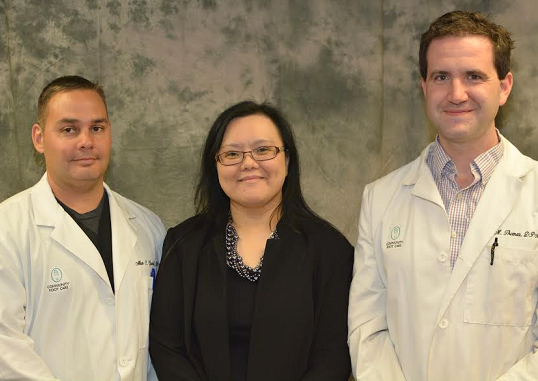
Dr. Belinda Dotter, myself and one of the medical assistants

Within 5 minutes of running on the treadmill I felt a sudden sharp, stabbing pain in my toe. From past experience, I knew exactly what it was- an ingrown toenail. It was too painful to continue my workout so I headed home.

An ingrown toenail doesn't sound like much, but these can cause a lot of pain if left untreated and can affect simple tasks in your everyday life.  If yours are anything like mine, then even the smallest touch will make you cringe. An ingrown toenail is a common condition in which the corner or side of one of your toenails (usually the big toe) grows into the soft flesh of that toe. The result is pain, redness, swelling, and sometimes, an infection.

The old me would have taken matters into my own hand and tried to remove the ingrown toenail myself. You would think from past experience I would know this is a big no-no but that never stopped me before. I always made it 10x worse trying to remove the corner of the nail myself. The new me works for a podiatrist, so at this point I know better.

The following day I decided to schedule an appointment with Community Foot Specialists. I wanted to get back into a regular exercise routine, I wanted to take my children to the park, I wanted to do regular every day activities without the almost unbearable pain from the ingrown toenail.

At Community Foot Specialists, we try to get our patients in as quickly as possible so I was relieved that I was able to be seen for an evaluation the next day by Dr. Dotter at our Main Street location in Dayton, Ohio.

Based upon the doctor’s professional opinion, I was able to be seen the following day for the procedure. And I was a nervous wreck. I’m not sure why... it’s not like I didn't know what was going to happen. But the thought of my toe being numbed and my nail being clipped out had me ready to cancel my appointment.

Once I had arrived at my destination the medical assistant got me right back to a room. Within minutes, the doctor came in and talked to me about what was going to happen. She then numbed my toe. She was very gentle and to be completely honest I couldn't really feel it. I waited for my entire toe to numb before she came back to remove the nail. It only took a couple of minutes and she only took out the corner. As a woman, I was worried that the doctor would take off more toenail than necessary. I mean, it IS Summer and I love my flip flops!

Relief! That’s all I could think. I couldn't believe how easy and quick the procedure was.


If you are dealing with an ingrown toenail, or what you think may be an ingrown toe nail, I highly recommend coming in to see the doctors at Community Foot Specialists. And I’m not just saying that because I work here. At Community Foot Specialists our doctor’s mission is to provide patient centered, high-quality foot and ankle care, delivered by knowledgeable, compassionate podiatrists and a professional, caring staff… and I experienced exactly that.

Community Foot Specialists - Podiatrists/Foot & Ankle Surgeons Serving Dayton and Springfield, Ohio Call today to schedule your appointment! (937) 426-9500

Wednesday, September 19, 2012

Common Foot Conditions and Treatments


(source

IngrownToenail- When a toenail is ingrown, the nail is curved downward and grows into the skin, usually at the nail borders (the side of the nail). This “digging in” of the nail irritates the skin, often creating pain, redness, swelling, and warmth in the toe. If an ingrown nail causes a break in the skin, bacteria may enter and cause an infection in the area, which is often marked by drainage and a foul odor. However, even if your toe isn’t painful, red, swollen, or warm, a nail that curves downward into the skin can progress to an infection.
Treatment- If an infection is present, an oral antibiotic may be prescribed. A simple procedure, often performed in the office, is commonly needed to ease the pain and remove the offending nail. Surgery may involve numbing the toe and removing a corner of the nail, a larger portion of the nail, or the entire nail. A chemical or the entire root is taken out to make sure the ingrown is permanently removed.

HeelPain- is most often caused by plantar fasciitis. Heel pain may also be due to other causes such as a stress fracture, tendonitis, arthritis, nerve irritation, or rarely a cyst. Because there are several potential causes, it is important to have heel pain properly diagnosed. A podiatric foot and ankle surgeon is best trained to distinguish between all the possibilities and determine the underlying source of your heel pain.
Treatment- Stretching exercises. Exercises that stretch out the calf muscles help ease pain and assist with recovery. Avoid going barefoot. When you walk without shoes, you put undue strain and stress on your plantar fascia. Ice. Putting an ice pack on your heel for 10 minutes several times a day helps reduce inflammation. Limit activities. Cut down on extended physical activities to give your heel a rest. Shoe modifications. Wearing supportive shoes that have good arch support and a slightly raised heel reduces stress on the plantar fascia. Your shoes should provide a comfortable environment for the foot. Lose weight. Extra pounds put extra stress on your plantar fascia. Padding and strapping. Placing pads in the shoe softens the impact of walking. Strapping helps support the foot and reduce strain on the fascia. Orthotic devices. Custom orthotic devices that fit into your shoe help correct the underlying structural abnormalities causing the plantar fasciitis. Injection therapy. In some cases, corticosteroid injections are used to help reduce the inflammation and relieve pain. Removable walking cast. A removable walking cast may be used to keep your foot immobile for a few weeks to allow it to rest and heal. Night splint. Wearing a night splint allows you to maintain an extended stretch of the plantar fascia while sleeping. This may help reduce the morning pain.

Plantar Warts- A wart is a small growth on the skin that develops when the skin is infected by a virus. Warts can develop anywhere on the foot, but typically they appear on the bottom (plantar side) of the foot. A solitary wart is a single wart. It often increases in size and may eventually multiply, forming additional satellite” warts. Mosaic warts are a cluster of several small warts growing closely together in one area. Mosaic warts are more difficult to treat than solitary warts.
Treatment-  The foot and ankle surgeon may use topical or oral treatments, laser therapy, cryotherapy (freezing), or surgery to remove the wart. Regardless of the treatment approaches undertaken, it is important that the patient follow the surgeons instructions, including all home care and medication that has been prescribed, as well as follow-up visits with the surgeon. Warts may return, requiring further treatment.

If you or someone you know is experiencing any of these foot problems, contact your Dayton/Springfield podiatrist at Community Foot Specialists. 937-426-9500

Monday, September 10, 2012

Children's Heel Pain: Not Just Growing Pains!

(source)
If your child complains of heel pain, you should definitely take their complaints seriously. Children particularly those who are athletic/ physically active- may have what is called Sever’s disease. This condition occurs in children during their growth stages when the growth plate in the heel is injured. In early puberty, bones grow faster than muscles and tendons. Muscles and tendons become tight as a result and the heel is less flexible. When the child stands or bears any weight on his or her heel, injuring the heel and causing Sever’s disease. 

Signs that your child may be suffering from Sever’s disease include pain in one or both heels that usually occur with activity (usually around the time your child would begin a new sport or season), A tendency to tiptoe, walking with a limp, increased intensity of pain when running or jumping. Another sign is if your child’s heel hurts when you squeeze both sides toward the very back of the heel. The good news about Sever’s disease is that it is highly treatable with non-invasive methods. The first thing to do is to stop or limit any activity that causes the child pain. Treat the injured heel with ice for 20 minutes at a time, 3 times a day. Stretching exercises can also help lessen the pain of Sever’s disease: particularly those that stretch the hamstring and calf muscles and tendons on the back of the leg. These stretches should be performed 2 or 3 times a day and held for about 20 seconds in both legs, even if only one heel is experiencing pain.

If your child is having heel pain, contact Community Foot Specialists serving the Greater Dayton area in 6 convenient locations- 937-426-9500

Thursday, September 6, 2012

Diabetic Foot Care Guidelines

(source)

  • Inspect your feet daily. Check for cuts, blisters, redness, swelling, or nail problems. Use a magnifying hand mirror to look at the bottom of your feet. Call your Community Foot Specialist in Springfield and Dayton at 937-426-9500 if you notice anything
  • Wash your feet in lukewarm (not hot!) water. Keep your feet clean by washing them daily. But only use lukewarm water—the temperature youd use on a newborn baby.
  • Be gentle when bathing your feet. Wash them using a soft washcloth or sponge. Dry by blotting or patting—and make sure to carefully dry between the toes.
  • Moisturize your feet—but not between your toes. Use a moisturizer daily to keep dry skin from itching or cracking. But DON’T moisturize between the toes—this could encourage a fungal infection.
  • Cut nails carefully—and straight across. Also, file the edges. Dont cut them too short, since this could lead to ingrown toe nails.
  • Never trim corns or calluses. No bathroom surgery”—let your doctor do the job.
  • Wear clean, dry socks. Change them daily.
  • Avoid the wrong type of socks. Avoid tight elastic bands (they reduce circulation). Dont wear thick or bulky socks (they can fit poorly and irritate the skin).
  • Wear socks to bed. If your feet get cold at night, wear socks. NEVER use a heating pad or hot water bottle.
  • Shake out your shoes and inspect the inside before wearing. Remember, you may not feel a pebble—so always shake out your shoes before putting them on.
  • Keep your feet warm and dry. Dont get your feet wet in snow or rain. Wear warm socks and shoes in winter.
  • Never walk barefoot. Not even at home! You could step on something and get a scratch or cut.
  • Take care of your diabetes. Keep your blood sugar levels under control.
  • Dont smoke. Smoking restricts blood flow in your feet.
  • Get periodic foot exams. See your podiatric foot and ankle surgeon at Community Foot Specialists in Dayton and surrounding areas on a regular basis for an examination to help prevent the foot complications of diabetes. Call us today if you have any questions, 937-426-9500
Check out one of our podiatrists, Dr. Thomas at Community Foot Specialists talking more about diabetes and your feet!


Did you know we have a book on diabetes and how it affects your feet? Get your FREE copy today by clicking here. From your friends at the Community Foot Specialists!